


Author: Hannah Tookey
Over the past few years, we’ve spoken to hundreds of donors, advocates, and researchers who care deeply about improving the lives of the most neglected animals. Many want to support work in areas like farmed insects, farmed shrimp, or wild animal welfare, but aren’t quite sure how because these fields are large and complex. The scale of suffering is vast, evidence bases are limited, and the landscape is evolving quickly. It can be difficult to know what’s most promising, or how to move forward confidently.
At Rethink Priorities, under our Neglected Animals Program, we have spent years trying to improve the lives of these animals. Our team has investigated sentience and welfare issues, coordinated strategy across organizations, mapped advocacy and industry landscapes, supported emerging groups, and incubated new interventions. That vantage point has given us a broad, comparative view of these fields as they develop.
Drawing on that experience:
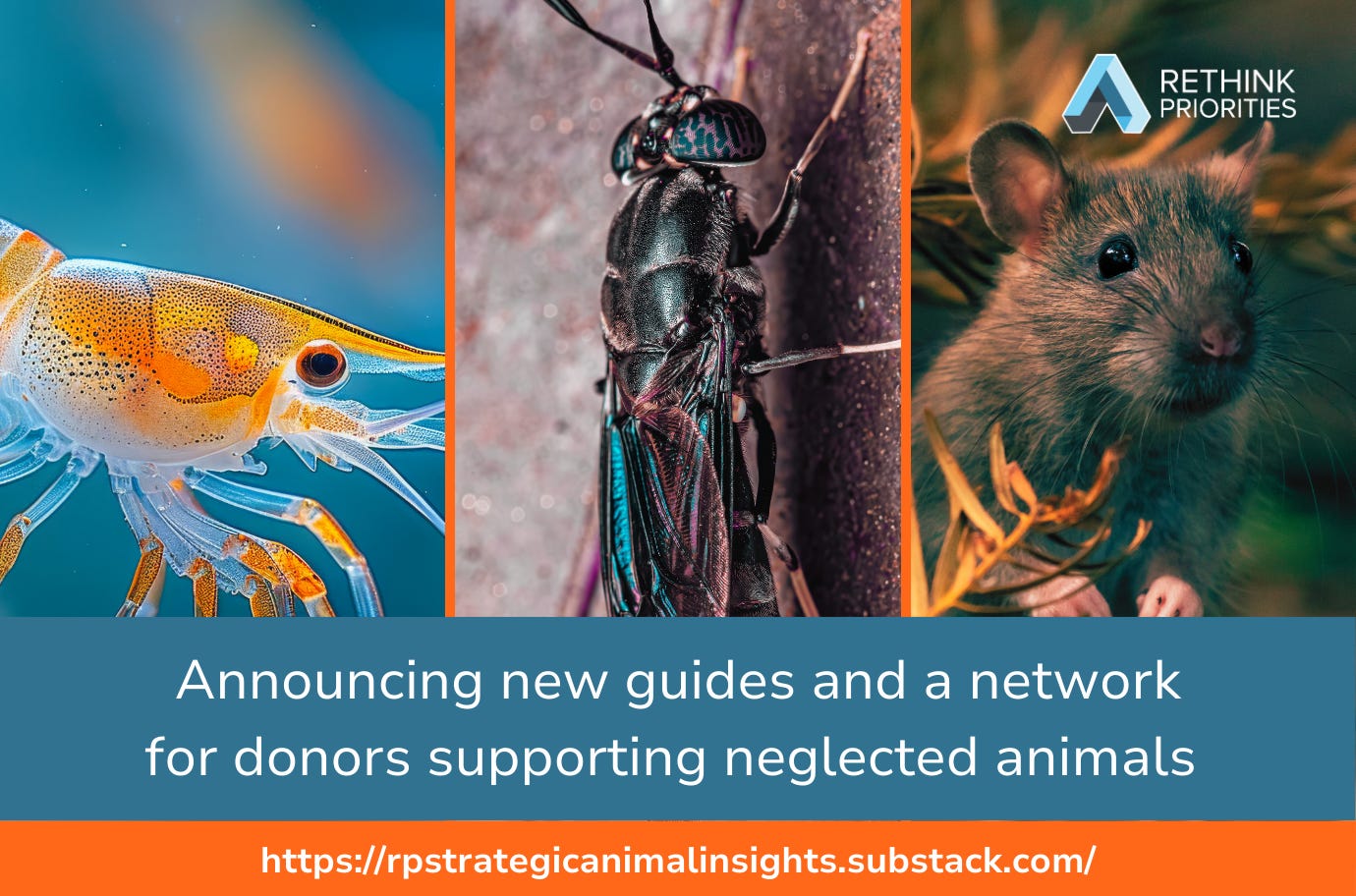
We’ve created three donor guides for: farmed insects, farmed shrimp, and wild animal welfare. Our goal is to help donors understand what is known, what remains uncertain, where there is momentum, and how to support high-impact work even in early-stage and rapidly changing environments.
In early 2026, we will launch a Neglected Animals Giving Network to support donors who want to learn about and contribute to furthering work in these fields. We invite interested donors and philanthropy advisors to complete our expression-of-interest form or contact development@rethinkpriorities.org.
Why donors may find neglected animal fields hard to navigate
Across farmed insects, farmed shrimp, and wild animal welfare, donors encounter similar challenges because the information environment can be unusually difficult to navigate. Below are several considerations we’ve found especially important when thinking about these fields.
1. Much of the most relevant information is confidential.
In several of these areas—especially insects and shrimp—much strategically important work is not publicly documented. Industry dynamics, advocacy plans, and emerging groups often cannot be shared widely due to their sensitivity. Donors may search for promising opportunities and find very little, even when strong options exist. This lack of public visibility makes the landscape appear less developed than it really is.
2. The fields are early-stage, which creates both urgency and uncertainty.
Industry expansion and the scale of suffering create pressure to act quickly. At the same time, these fields lack broad evidence bases, standardized welfare science, and long-term evaluations. Fundamental questions remain, for example; “Which conditions affect farmed shrimp most?”, but much of the groundwork needed to answer them—such as welfare science, stakeholder alignment, movement capacity-building—is still being established.
3. There is little comparative or tracking data to support prioritization.
Unlike corporate cage-free or broiler welfare work, insects, shrimp, and wild animals don’t yet have robust systems for comparing interventions or tracking long-term outcomes. In wild animal welfare, ecological complexity adds another layer of difficulty, making measurement especially challenging.
4. These fields are early-stage in different ways.
Farmed insect welfare is in an early formative phase with the potential to shape decades of industry practice before norms become entrenched. By contrast, shrimp welfare gained early momentum, but risks plateauing without deeper welfare asks and broader regional engagement. Wild animal welfare sits in a different position again: long-term research has begun to translate into concrete, near-term interventions, but must do so with ecological and political caution. These differences affect what high-impact giving looks like, which interventions are feasible, and where the most important bottlenecks lie.
5. All interventions carry risks, but inaction carries its own.
Donors who care about neglected animals often have expansive moral circles, which can make concerns about backfire risks particularly salient. These considerations matter, but they are not unique to insects, shrimp, or wild animals. Nearly all animal welfare interventions face similar uncertainties, though they often receive more attention in newer areas. Yet inaction–especially during critical windows when norms and industries are still forming–can pose greater long-term risks than carefully considered early steps. Across all areas of animal advocacy, a balanced, iterative approach–making measured progress while updating based on new evidence and lessons from more established fields–helps manage risks while still capturing high-leverage opportunities to improve welfare at scale.
6. Limited movement capacity constrains how quickly the fields can grow.
Because these areas are still emerging, there are relatively few organizations or advocates with the necessary expertise, local relationships, or technical skills. In many major producer regions (which are primarily in the Global South), new organizations need to be launched—and founders recruited—before advocacy can begin. This makes it especially important to be strategic about where we invest resources or incubate new groups, and these decisions often require substantial analysis of local political and economic conditions. At the same time, capacity-building in these early-stage contexts can be highly cost-effective: small investments can enable tests of new approaches and generate momentum that may otherwise be difficult to achieve organically within a similar timeframe.
These challenges help explain why seemingly high-potential fields can feel opaque or difficult to navigate. Yet, despite the uncertainties, meaningful opportunities exist now. Our three donor guides aim to clarify these landscapes and highlight the work that we believe is most promising.
Our donor guides for neglected animal giving
Below are brief overviews of three donor guides developed by Rethink Priorities (RP), with each summarizing the funding landscape, identifying strategic bottlenecks, and offering our priority recommendations. Where recommendations involve confidential work, we welcome private conversations with donors and advisors.
Because some material is highly sensitive, full guides are shared only on request. Please complete this form to request access to the guides.
Farmed insect welfare
While trillions of insects are already farmed annually, industry norms and regulatory expectations are still being established. This creates a narrow window in which foundational welfare science, early advocacy, and coordinated strategy could meaningfully shape long-term industry practices.
This guide highlights five priority funding areas across research, advocacy, and capacity building.
We make several specific recommendations, but many promising opportunities remain confidential and can only be shared privately.
Shrimp welfare
Early advocacy wins have demonstrated tractability, yet most shrimp are farmed in regions with little welfare advocacy, and existing commitments address only a fraction of overall suffering.
Our guide focuses on two major bottlenecks in research and advocacy. Several emerging groups and confidential initiatives are actively working on these challenges.
Wild animal welfare
Wild animal welfare is beginning to transition from long-term foundational research to the emergence of concrete, near-term intervention opportunities. However, success in this field still depends heavily on ensuring interventions are technically feasible and robust to ecological uncertainty, and will likely require achieving public and political support.
Our guide outlines and provides examples of three preconditions:
Valid measurement
Technical ability
Stakeholder buy-in
We believe that all worthwhile funding opportunities should demonstrate at least one of these.
We don’t make strong assumptions about the welfare of wild animals, but we do prioritize taking action now while remaining mindful of potential risks. We therefore highlight opportunities for seed funding and field-building work that align with this approach. In early 2026, Rethink Priorities will also publish a database of near-term wild animal welfare interventions to support more detailed prioritization.
Invitation: join RP’s Neglected Animals Giving Network
Because so much of the most promising work in these fields cannot be shared publicly, we are creating a new way for donors and advisors to stay closely informed.
Beginning in early 2026, we will host private briefings, share early access to research, and offer opportunities to speak directly with our researchers about emerging opportunities across farmed insects, shrimp, and wild animal welfare.
This network is designed for donors who want to engage deeply with these neglected areas and help shape their development.
If you’re interested in joining or learning more, we would be glad to connect.
Or email development@rethinkpriorities.org
Thank you! We’ll be back on January 6.
Thank you for taking the time to read our Substack. This will be our last Strategic Animal Insights post of 2025. We’ll be back on Substack on January 6, 2026!
Get a preview of what RP has in store for 2026 here, and subscribe below to receive our next Substack posts! To support our work, consider becoming a paid subscriber. Your support enables us to focus on identifying and addressing the most pressing challenges facing animals.
Every contribution—no matter the size—helps us remain independent, responsive, and impact-focused.
As usual, we encourage you to share your feedback and ideas.
By default, we’re sharing this Substack via email with Rethink Priorities newsletter members who indicated interest in animal welfare. Please feel free to unsubscribe if this is no longer a topic that you care deeply about, or if you prefer to just stick with our general newsletter.
Hi Rethink Priorities,
I hope you don’t mind that I’m reaching you via comments. Substack has limited my direct messages today to notify you that I’ve included you in my post.
I’ve included the RP Strategic Animal Insights page in my new post listing over 200 vegan resources on Substack. I hope you like it! I’m hoping to help readers discover more of the vegan publishing community here.
Here’s the link if you’d like to take a look:
https://plus.shovelandcrunch.com/p/vegan-substack-resources-guide-a
Please let me know if you’d like any updates or edits to your entry. If you feel this guide is useful, you’re welcome to share or restack so others can find it too. But no worries if not. Thanks for doing everything you do! Have a wonderful day.
Shell