


Between July and September 2024, we prepared a collection of case studies examining initiatives designed to increase plant-based consumption. They were commissioned by an anonymous funder to offer critical insights for stakeholders seeking to accelerate the transition to plant-rich food systems.
Whether you're a policymaker, food industry leader, or advocate, this collection offers insights into actionable frameworks that can be used to advance sustainable food systems.
Below, we present a synthesis of key findings, insights from each of the five case studies, and links to the complete reports. We encourage readers to examine the full documentation to understand the contextual factors, implementation variables, and evaluation metrics contributing to each intervention's effectiveness.
Authors of the case studies: Neil Dullaghan and Ben Stevenson.
Key insights
Strategic implementation principles
Work with many partners: Successful food transition programs bring together government, businesses, nonprofits, and researchers to create more powerful change.
Start small and grow: Begin with smaller test programs before expanding, which reduces pushback and allows for improvements based on early results.
Set clear, measurable goals: Use specific targets with deadlines to track progress and make adjustments when needed.
Fit local culture: Design programs that respect local food traditions, language preferences, and community values.
Focus on the positives: Highlight new choices and benefits, rather than what people should give up or avoid.
Critical success factors
Get official support: Backing from government or institutional leaders provides authority and opens doors for implementation.
Use the right words: Choose language that connects with people's existing values and avoids terms that might trigger resistance.
Make plant-based affordable: Ensure plant-based options cost the same as meat options and place them where consumers can easily find them.
Train the right people: Provide thorough training for food service staff to ensure plant-based meals taste good and look appealing.
Show real results: Use good measurement systems to show the actual environmental, health, and cost benefits achieved.
Case Study: Coolfood
Problem profile: Food service institutions accounted for more than half of total food expenditures in the US in 2022.
Initiative: Coolfood helps food service businesses reduce their food-related greenhouse gas emission by developing strategic partnerships and offering resources leveraging their expertise in behavioral science, consumer marketing, and environmental research. By providing healthy and sustainable plant-based dishes, restaurants, canteens, and cafes have the opportunity to influence consumers’ eating habits on a large scale.
Results:
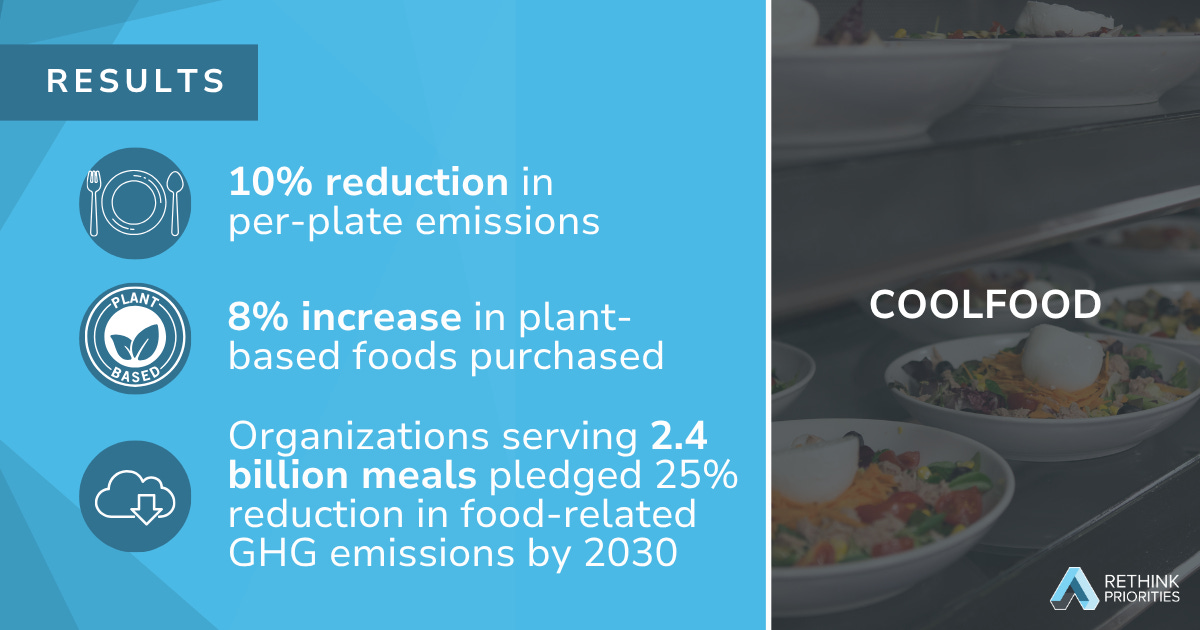
Organizations collectively serving 9 billion meals a year work with Coolfood. Of these, organizations serving 2.5 billion meals a year have signed up to the Coolfood Pledge, which commits to a 25% reduction in food-related GHG emissions by 2030.
Pledge participants who joined before 2022 (and by the time of this case study) had achieved a 10% reduction in per-plate emissions and an 8% increase in plant-based foods purchased.

Lessons learned:
The value of encouraging institutions to make a start, even with imperfect data on food purchasing. Once they see how even small changes can add up to make a difference, their motivation to change often begins to grow.
Behavioral research can be turned into actionable insights suitable for different audiences (schools, hospitals, and businesses).
Emphasizing choice rather than taking away options or restricting choice helps gain buy-in.
To ensure meaningful progress, it is essential to have robust tracking mechanisms that monitor changes in food procurement, menu choices, and overall greenhouse gas emissions.
Case Study: Plant-based food promotion in German retailers
Problem profile: Each year, retailers collectively sell millions of tonnes of meat, the production of which causes considerable environmental damage. But if they are willing, they can nudge customers towards alternatives that are healthier, greener, and kinder to animals.
Initiative: In October 2023, Lidl Germany published its Protein Strategy, which included a commitment to achieve a 20/80 plant/animal protein split by 2030 (up from 11/89 in 2021). It is also committed to achieving price parity for comparable plant-based and animal-based proteins. Lidl Germany is seeking to achieve their goal through:
Increasing plant-based product range
Putting plant-based items in the meat aislePricing plant-based items equivalent to meat items.
Results:
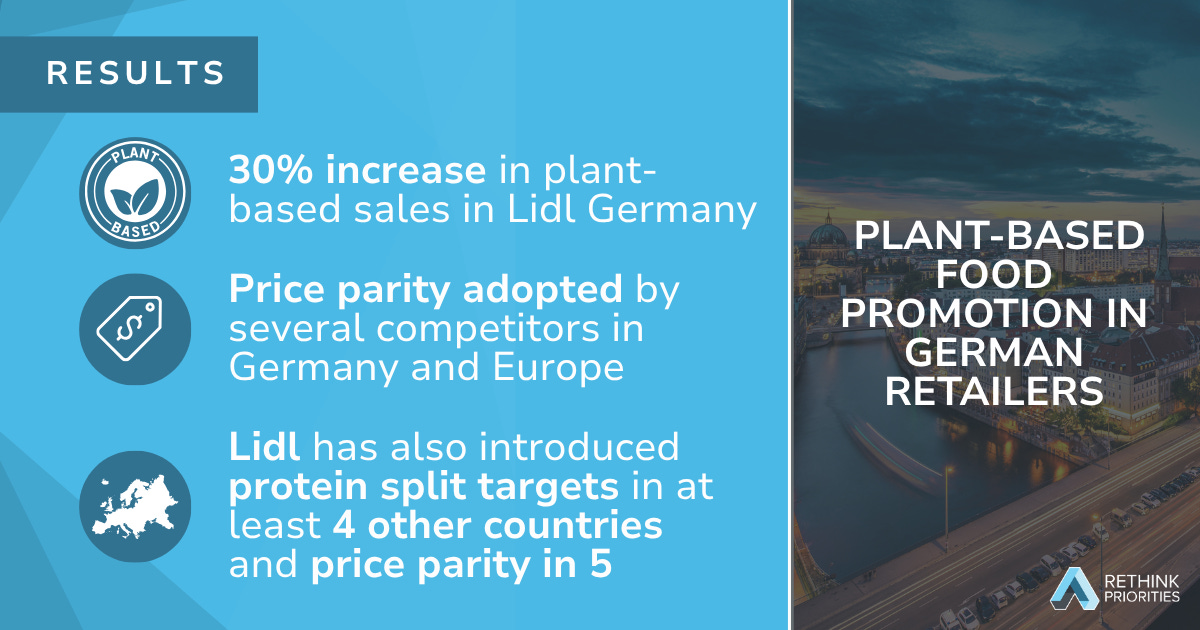
Lidl Germany subsequently reported that plant-based sales increased by 30%.
Price parity has now been adopted by several competitors in Germany and elsewhere in Europe.
Lidl has also introduced protein split targets in at least four other countries and price parity in five.
Lidl Germany had yet to report on the progress towards achieving its Protein Strategy targets at the time the case study was conducted, and the evidence base for its strategies was thin. Notwithstanding this, if Lidl Germany were to achieve its targets, it could potentially lower CO2 equivalent GHG emissions by 450K tonnes and reduce land use by 1300 km2 (both ~10% of its current environmental impact from meat retail). Savings could be around 3x larger if Lidl were to make similar progress across its entire international operations.

Lessons learned:
We believe protein split targets, such as the one Lidl Germany introduced, are more likely to reduce meat sales than plant-based sales targets that have been introduced by several other European retailers.
Lidl Germany was inspired to adopt protein split targets by NGOs taking an “inside-game” campaign approach, which framed their advocacy as helping retailers find best practices for achieving this goal.
Implementation was made possible by researchers who developed a methodology to track protein.
Several contextual factors contributed to the success: Lidl Germany already had a strong reputation for plant-based offerings; Germany was experiencing a pre-existing downward trend in meat consumption; and the protein split goal aligned with pre-existing environmental and health goals.
More ambitious targets set by grocers in the Netherlands also helped set a useful precedent.
Case Study: Alternative protein company in India
Problem profile: While alternative proteins can play an important role in mitigating the harmful consequences of growing meat consumption, alternative protein investments are largely concentrated in the West. Still, meat consumption is expected to grow fastest in low- and middle-income countries, such as India.
Initiative: GoodDot is one of India’s largest and most successful plant-based meat companies, dedicated to providing affordable, locally tailored alternatives to conventional meat.
Results:
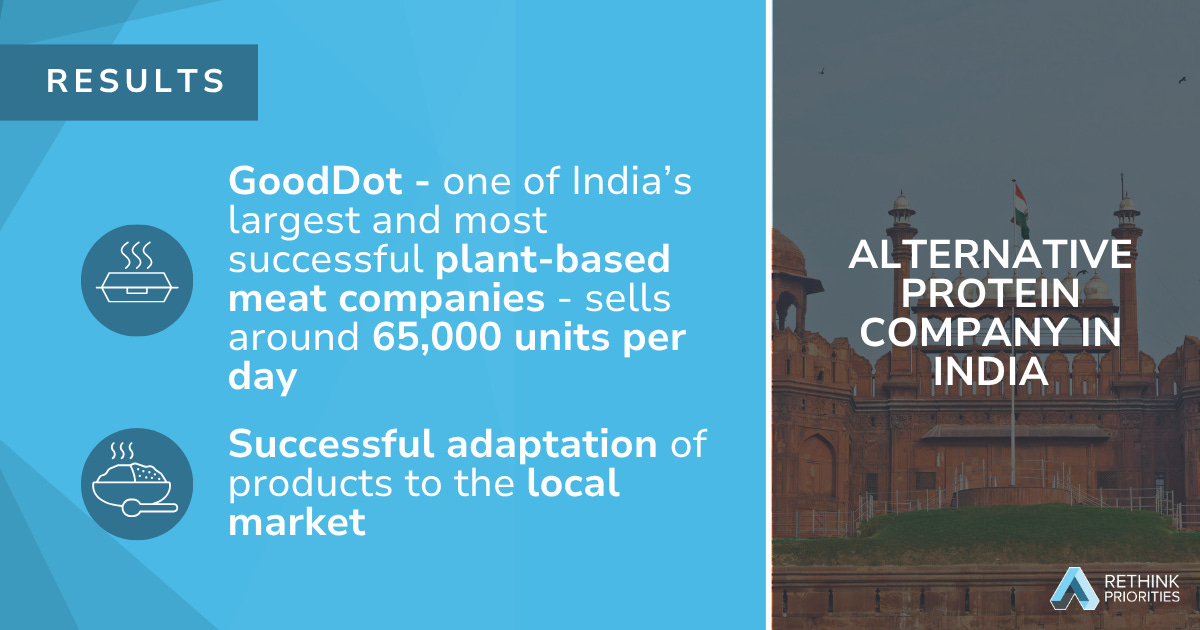
Sells approximately 65,000 units daily.
Products available in over 10,000 outlets, including hotels and roadside dhabas.
Successfully expanded to rural markets despite infrastructure limitations.
Despite rapid growth and a profitable business, GoodDot’s current sales are only enough to displace a tiny fraction of India’s meat consumption.

Lessons learned:
GoodDot’s biggest challenge has always been capital constraints. Their solution has been capital efficiency (focused on R&D spending). The company believes philanthropists should consider investing in companies directly, not, e.g., fund public research efforts.
Factors underpinning their success include:
Adapting products to suit the local market, like dhaba curries and keema pau
Investing heavily in R&D to deliver:
Taste that is on par with animal meat
Prices that are well below animal meat (particularly for wholesale customers)
Shelf-stable products that can reach rural markets through trusted distributors
Case Study: Denmark’s plant-based food grant
Problem Profile: Denmark’s heavy reliance on meat poses significant environmental and public health challenges. The Danish agricultural sector is forecast to account for 40% of climate emissions by 2030, and the average Dane consumes almost three times as much red meat as is recommended by dietary guidelines.
Initiative: Responding to these issues in 2021, the Danish government agreed on a green transition of the agricultural sector, which proposed a National Action Plan for plant-based foods, a plant-based food grant, and subsidies for farmers transitioning to grow crops for human consumption.
Results:
While the initiatives have established a foundation for future growth, it remains premature to assess their success in shifting private consumption patterns sufficiently to motivate farmers to seek support for transitioning to plant-based crops for human consumption.
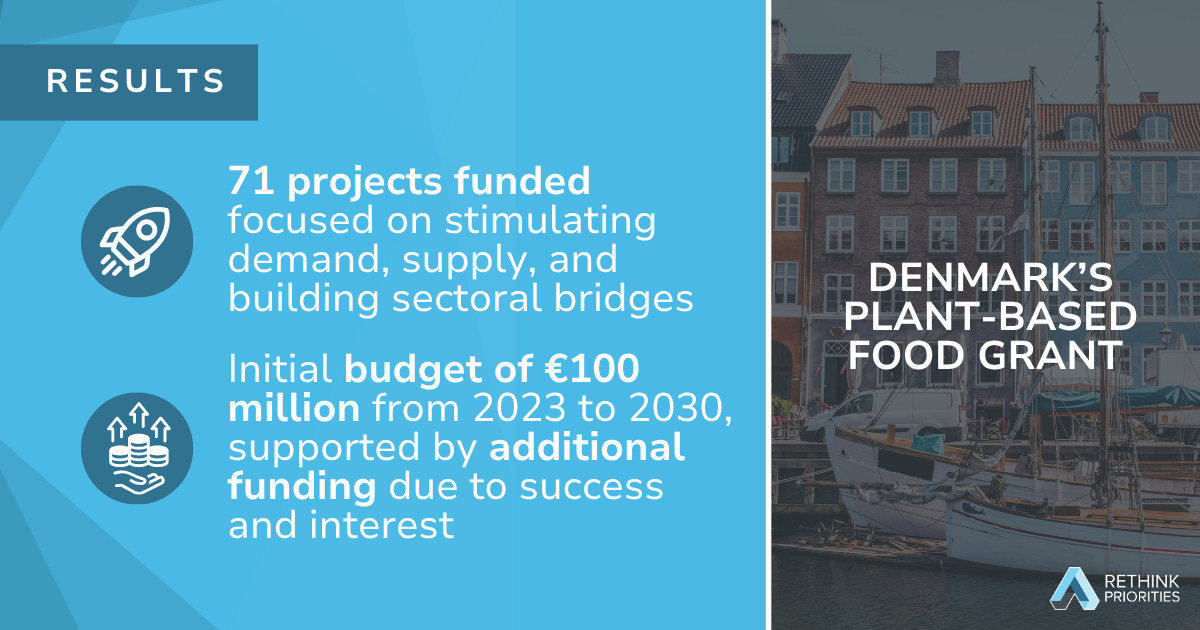
The Plant-Based Food Grant supports innovation and growth within Denmark’s plant-based food sector and aims to help stimulate demand and supply as well as help build sectoral bridges. The initial budget was around €100 million from 2023 to 2030, but success and interest led to additional funding shortly after launch. So far, it has funded 71 projects focused on stimulating demand and supply, and building sectoral bridges.
At the time the case study was conducted, the farmer subsidies program incentivizing farms to transition away from growing crops for animal feed and towards crops aimed at human consumption had limited uptake.

Lessons learned:
The value of strategic partnerships between NGOs, business, farmers, associations, and the government.
The benefits of strategic sequencing of low-risk, win-win “carrot” policies that build on each other and help avoid backlash.
The merits of inclusive, supportive (rather than restrictive or punitive) messaging and high-quality data around the economic potential of a plant-based foods system.
The potential advantages of securing initial funding to support plant-based foods, given the potential for future increases.
One critical lesson is the need for flexibility in what is considered “plant-based” and adopting a wider understanding of what counts toward that definition.
Case Study: New York City Mayor’s Office’s plant-based food policies
Problem profile: Food is the third-largest contributor to GHG emissions in New York City, and limited access to healthy foods exacerbates health disparities that exist across the city.
Initiative: To address these challenges, under Mayor Eric Adams, the Mayor’s Office for Food Policy (MOFP) has made improving access to plant-based foods a key component of its strategy to promote healthier eating habits across the city’s diverse population.
New York City was the first US city to sign the Coolfood Pledge. MOFP established its own Plant-Powered Carbon Challenge to encourage the private sector to reduce food-related carbon emissions by 25%. Meatless Mondays and Plant-Powered Fridays were introduced in schools across the city, and plant-based defaults were introduced at hospitals run by NYC Health + Hospitals.
Results:
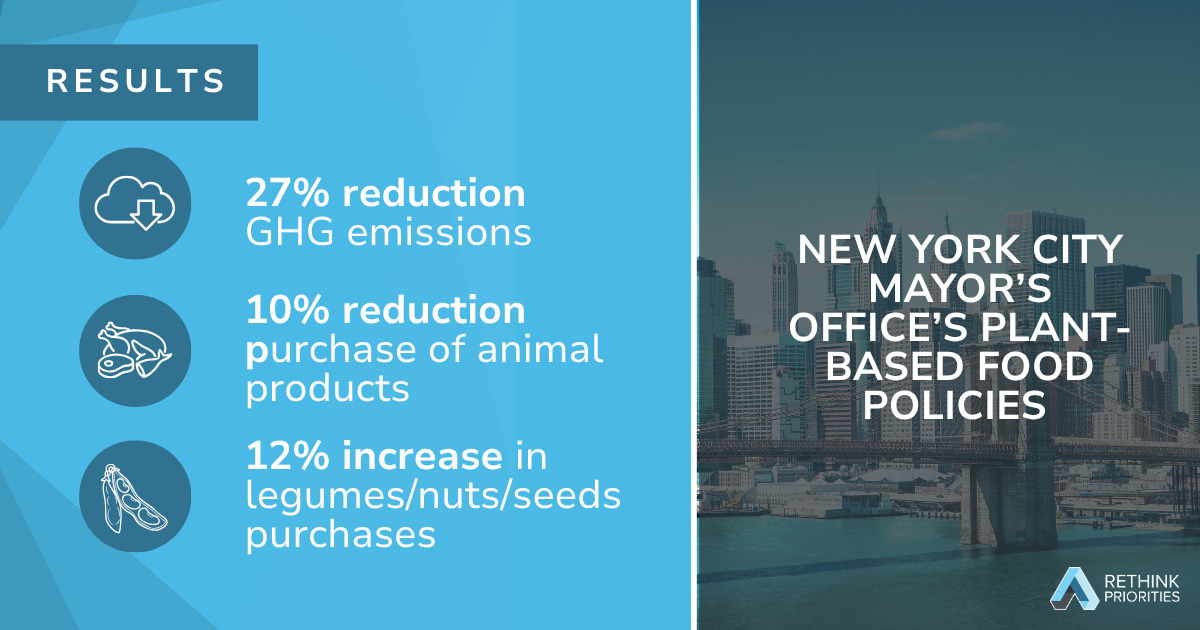
These measures helped the city achieve a 27% reduction in absolute GHG emissions across food expenditure between 2019 and 2022, as well as a 10% reduction in the purchase of animal products and a 12% increase in legumes/nuts/seeds purchases (by weight).
Lessons Learned: New York City’s experience has provided several insights that can help guide future efforts:
To ensure meaningful progress, it is essential to have robust tracking mechanisms that monitor changes in food procurement, menu choices, and overall greenhouse gas emissions.
It is critically important to pair plant-based dietary initiatives with the culinary workforce, and food education is critically important. Successful implementation goes beyond just offering plant-based options. They also need to be appealing and culturally relevant.
The soft launch of the Meatless Mondays pilot in Brooklyn schools provided valuable insights that informed the successful expansion of the initiative citywide, inspiring the subsequent Plant-Powered Fridays.
One critical lesson is the need for flexibility in what is considered “plant-based,” and taking a wide understanding of what counts. The terms “Plant-powered” and “plant-foward” resonate better than “vegan.”
Leveraging leadership has been essential. Mayor Eric Adams played a key role in promoting plant-based options. Cultivating a pipeline of individuals like Eric Adams who are passionate about this field could create more opportunities in other cities.

If you have any questions about this report, please contact us at:
ula@rethinkpriorities.org
Including animal and AI welfare in AI alignment (RP strategic animal webinars)

We also want to remind you that you can still sign up for our upcoming webinar with Adrià Moret, a philosophy researcher at the Centre for Animal Ethics at the University Pompeu Fabra, the University of Barcelona, and Editor-in-Chief of Animal Ethics Review. We’ll explore why including basic concern for nonhuman welfare when aligning frontier AI systems is important, how AI labs can do this with existing AI alignment techniques, and think about concrete, actionable steps that animal advocates and technical professionals can take to advance this goal.
Date: May 28, 2025 (9 AM PDT, 12 PM EDT, 5 PM BST, 6 PM CEST)
Sign up: https://lu.ma/gy3l2qek
Our recent work was covered in Vox
Our recent work on the future of farmed animal numbers, that we shared with you in our last substack, was featured in an article by Kenny Torrella The number of animals that humans are on pace to slaughter will shock you for Vox. Big thank you to our team members Hannah McKay and Sagar Shah for their great work on this report. You can read the summary and access the full report in our previous substack

Thank you
Thank you for taking the time to read our substack. We’ll continue providing this content for free, but if you find our work valuable, consider becoming a paid subscriber. Your support helps us focus on identifying and solving the most pressing challenges for animals.
Every contribution–no matter the size–helps us remain independent, responsive, and impact-focused.
As usual, we encourage you to share your feedback and ideas.
By default, we’re sharing this substack via email with Rethink Priorities newsletter members who indicated interest in animal welfare. Please feel free to unsubscribe if this is no longer a topic that you care deeply about, or if you prefer to just stick with our general newsletter.