


Hi, I’m Daniela Waldhorn, Animal Welfare Director at Rethink Priorities, and I’m delighted to welcome you to our Substack!
Over the past few months, our team has been deeply engaged in refining our strategic direction, carefully evaluating where we can create the most meaningful change for animals. One important improvement we plan is to provide even greater support to the funders, organizations, policymakers, and individuals interested in advancing animal welfare. This substack supports this goal by delivering insights from our strategically relevant work in a reader-friendly, accessible format.
We’re sharing this substack via email with Rethink Priorities newsletter members who indicated interest in animal welfare. Please feel free to unsubscribe if this is no longer a topic that you care deeply about, or if you prefer to just stick with our general newsletter.
In this first post, we share our forecasting work on farmed animal numbers through 2033. Understanding these population trajectories is crucial for advocates, funders, and policymakers as they allocate resources and develop interventions. This forecasting represents the kind of foundational research we're committed to producing—evidence that can transform how the animal welfare movement makes strategic decisions in both the near and long term. We also want to invite you to our upcoming webinar Including Animal and AI Welfare in AI Alignment.
We look forward to sharing these insights with you and welcome both your thoughts and questions as we build this community together.
THE FUTURE OF FARMED ANIMALS: A 2033 FORECAST
Authors: Hannah McKay, Sagar Shah
Hundreds of billions of animals are raised on farms every year. While the number has steadily increased since the 1960s (see, e.g., Ritchie et al., 2023), figures often exclude invertebrates and aquatic animals. When they are included, estimates suggest that farmed shrimps currently dominate the picture, with 230 billion alive on farms at any given time (Waldhorn & Autric, 2023). With billions of dollars being invested in scaling insect farming (Shah, 2024), the picture could change again. So, how many animals will be farmed in the future? And to what species groups will they belong?
We produced rough-and-ready forecasts of the number of animals farmed in 2033 with the aim of helping advocates and funders with prioritization decisions. We focus on the most numerous groups of farmed animals: broiler chickens, finfishes, shrimps, and select insect species.
FARMED ANIMAL NUMBERS COULD GROW BY TRILLIONS
Figure 1: According to our midpoint estimates, invertebrates could account for 95% of farmed animals slaughtered in 2033. Note that ‘Insects’ only includes black soldier fly larvae and mealworms.
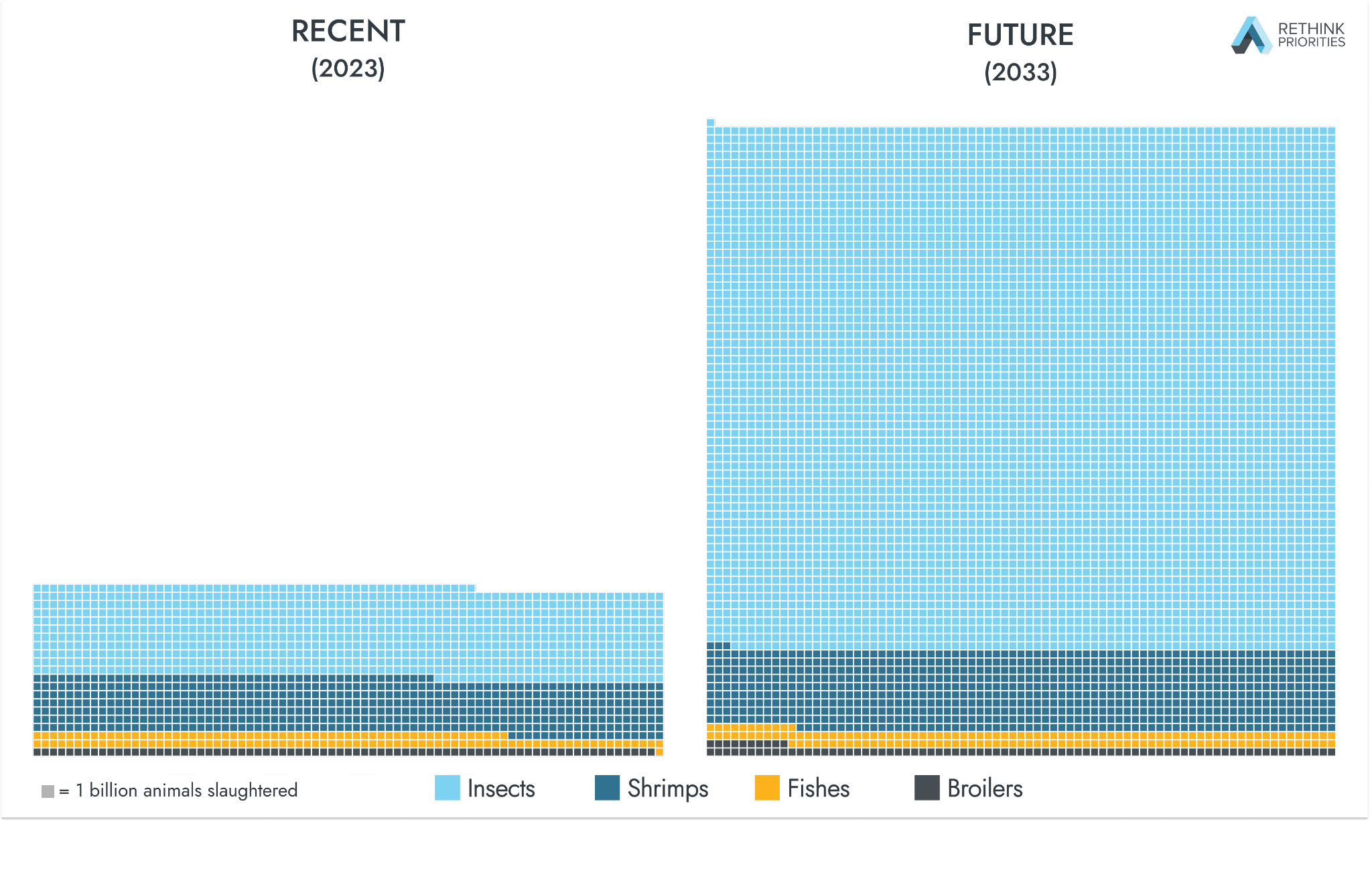
By 2033, we could see nearly 6 trillion farmed animals slaughtered annually, with invertebrates accounting for 95% of these animals.
Rapid growth ahead: We project a potential fourfold increase in slaughter numbers and a doubling of animals alive on farms at any moment in the next 10 years
Invertebrate dominance: Today, most farmed animals are invertebrates, and this majority will likely increase in the future.
Insect farming boom: Insect farming (particularly black soldier fly larvae and mealworms) is projected to grow rapidly, potentially surpassing shrimp as the most numerous farmed animal group.
INVERTEBRATE FARMING ACCOUNTS FOR MOST GROWTH
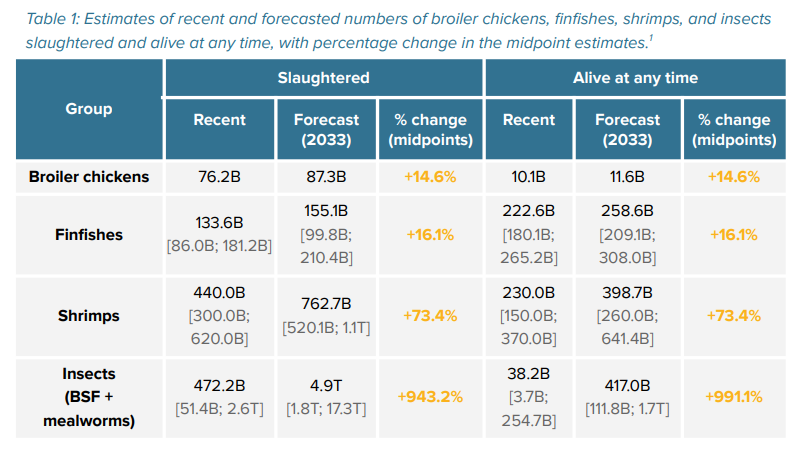
In 2023, invertebrates comprised over 50% of farmed animals alive at any time across the four major species groups we analyzed. By 2033, invertebrates could constitute three-quarters of farmed animals.
While the number of broiler chickens and finfishes show moderate increases of 15% and 16%, respectively, the scale of shrimp farming could grow by 73%. Insect production shows the largest change, with slaughter numbers surging by over 900%.
INTENSIFICATION AND INVESTMENT FUEL GROWTH
Alongside our estimated increase in farmed animal numbers, we predict minimal expansion in agricultural land use, suggesting production will grow through intensification, resulting in more factory farms with worse welfare conditions.
Intensification could also be supported by a shift towards smaller animals that can be reared at higher densities, such as insects and shrimps.
Insect farming investment (over $2 billion since 2014) is driving expansion, with potential to support growth in other animal agriculture sectors through use as feed. However, growth depends heavily on the success of insect farming business models and their ability to attract future investments.
IMPLICATIONS FOR ANIMAL ADVOCATES
Urgent research needs: Critical knowledge gaps exist around invertebrate sentience and welfare, particularly for insects.
Prepare for scale: The potential dramatic increase in farmed animal numbers demands preparation for both quantitative growth and qualitative changes in welfare challenges.
Interconnected impacts: Expanding insect farming may support growth in other sectors when used as feed for fish, chickens, and pigs.
ABOUT THIS FORECAST
While there are several uncertainties in our estimates, and specific numbers should be treated with caution, we hope the relative trends and projections offer valuable insights for resource allocation and advocacy planning. For more information, including methodology and detailed findings, download the full report below:
For any questions or comments on this research, please contact the lead author, Hannah McKay, at hannah@rethinkpriorities.org
Join Our Webinar: Including Animal and AI Welfare in AI Alignment
We’re launching the RP Strategic Animal Webinars series and want to invite you to our first talk and Q&A session: Including Animal and AI Welfare in AI Alignment
Date: May 28, 2025 (9 AM PDT, 12 PM EDT, 5 PM BST, 6 PM CEST)
About: Most current AI alignment efforts focus on protecting humans from potential AI harms. However, AI development also poses significant risks to nonhuman animals and potentially to sentient AI systems themselves, both now and in the future. Join researcher and chief editor Adrià Moret for an exploration into:
The importance of including basic concern for nonhuman welfare when aligning frontier AI systems
How AI labs can do this with existing AI alignment techniques
Concrete, actionable steps that animal advocates and technical professionals can take to advance this goal
Speaker: Adrià Moret is a philosophy researcher at the Centre for Animal Ethics at the University Pompeu Fabra, the University of Barcelona, and Editor-in-Chief of Animal Ethics Review.
Format: We’ll start with a focused 20-minute presentation followed by an extended interactive Q&A session with ample opportunity for discussion and exchange of ideas.
What to expect from this substack
Evidence-based analyses that identify neglected frontiers in animal welfare
Rigorous forecasts
Strategic evaluations of emerging intervention opportunities
Deep dives into overlooked populations
Assessments of policy landscapes and frameworks for decision-making that can help maximize welfare impacts
Bridging research and action by translating complex findings into practical insights for advocates, funders, and policymakers
Highlights for collaborative opportunities
Overall, we aim for a balance between deep analysis and accessible takeaways, ensuring you gain valuable strategic perspectives whether you're a funder allocating resources, an organization planning campaigns, or an individual looking to make more informed choices for animals.
We’ll continue providing this content for free, but if you find our work valuable, consider becoming a paid subscriber. Your support helps us focus on identifying and solving the most pressing challenges for animals.
Every contribution–no matter the size–helps us remain independent, responsive, and impact-focused.
Tell us what you think
Thank you for taking the time to read our substack. We’d love your feedback! Share your thoughts anonymously or simply reply to this email with suggestions for improvement!